TH1300
lTH6000 Bipolar High Current Source: powered by bidirectional power supply, internal circuit to achieve ± (100 A~10 kA) bipolar DC current programmable output. All range shifts do not use relays, which can realize fast commutation and range switching of high-current sources, effectively remove the influence of thermoelectric potential on resistance measurement, and avoid the shortcomings of poor contact with long-term relays. This bipolar current source scheme can provide high reliability assurance for industrial-grade products for metrological inspection.
Modular design of current source: using the combination output of multiple current sources, each current source has a built-in broadband current comparator for current measurement and control to ensure high stability and accuracy of current. Modular design improves maintenance efficiency even after maintenance; It is also easy to upgrade in the future, and the output range of the current can be expanded by adding a current source module, saving customers investment.
High stability and accuracy: the short-term stability of DC current output can reach 2.5ppm/min, 8ppm/h; Absolute accuracy of ±50 μ A/A. The software-controlled high current slowly rises and falls, reduces current surges, avoids power overshoot on the product under test, and provides a guarantee for high-precision sensor and shunt detection.
lTH1860 Bipolar Ultra-stable Constant Current Source: can accurately output ± ( 1 A~110 A) bipolar DC current, short-term stability up to 0 .4 ppm/min, 1.5ppm/h, absolute accuracy of ±15 μ A/A, is a constant current source with ultra-low noise, high precision, high linearity, and better fineness, which has been upgraded to an unprecedented level of accuracy and ultra-low noise in the commercial instrument market 。
lTH0740A Standard Resistance Measuring Device: can accurately output ± (0.1 mA~1 A) bipolar DC current, external ultra-stable standard resistor, the realization range is 1Ω~ Quantity transmission of standard resistance of 100 kΩ; With dual-channel voltage ratio measurement function, with ultra-precision current proportional extender (can be cascaded), ultra-stable standard resistor and current polarity exchange can realize the range of 0.1 μ Ω~1 Ω ultra-high accuracy resistance or ratio transmission.
lUltra-stable Standard Resistance: It is an air-type standard resistance with an annual stability of 0 2 ppm, can be used at (23 ± 5)°C, and achieves ultra-high stability without the need for a thermostatic oil sump.
lStandard Resistance Multiplexer: multiple standard resistors of different specifications are connected at the same time, and according to the calibration requirements when used, the standard resistors of different specifications that have been accessed are switched by program control, reducing the user's repeated wiring steps and effectively improving the calibration efficiency.
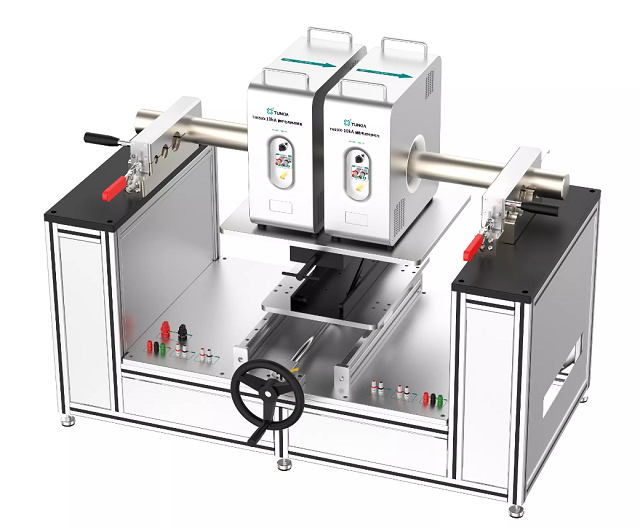
lSensor Special Test Tooling: designed for the fast wiring of the through-core high-current sensor, equipped with a detachable current copper rod, which is conducive to the formation of a uniform magnetic field between the tested and the standard sensor, and further reduces the measurement error; And built-in sensor secondary signal measurement module and power supply module, can complete the proportional error, linearity error, power consumption and other detection items of the sensor.
lSpecial Test Position for Shunt: A special bracket for high-current wiring is designed to be a special device test position, which is convenient for accessing the DC shunt. With the high-precision shunt secondary voltage measurement module, the error detection of the shunt can be realized, and R(I), R(t) and other curves can be drawn.
lSystem Traceability: It can facilitate traceability calibration of large currents, either by tracing the independent output of a single current source, or by tracing the overall output of all current sources.
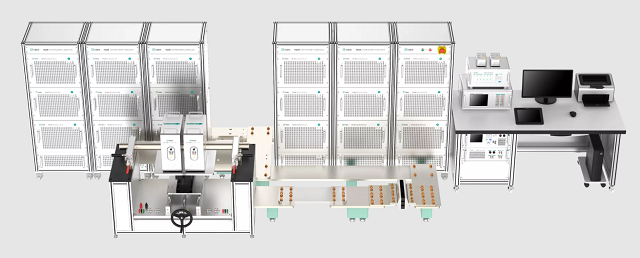
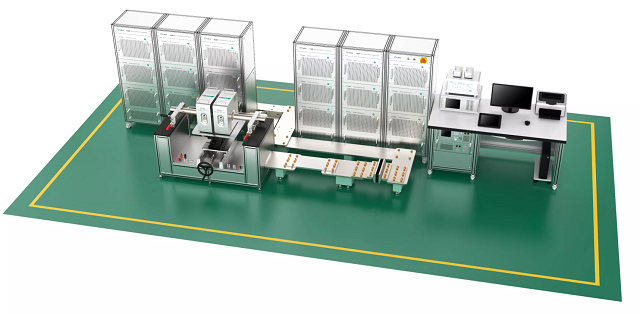
TH1300 can be fully automatic programmable output ± ( 0.1 mA~10 kA) with high precision, high stability, wide range of DC current. It is suitable for calibrating DC shunts with resistance value of 0.1 μΩ~100 kΩ, standard resistors, and also suitable for calibration of high-precision current sensors. It provides a reliable technical guarantee for the establishment of high-precision current and resistance transmission system for high-level metrology laboratories.
Equipped with three sets of bipolar current sources with different output ranges, all of which can be quickly commutated through program control, effectively removing the influence of thermoelectric potential on measurement and avoiding the disadvantage of poor contact with long-term relays Provide high reliability assurance for industrial-grade products for measurement and testing. Among them, TH6000 is a modular design of high-current sources, multiple current sources can be directly connected in parallel to generate ± ( 100A~10kA DC high current; TH1860 can accurately output ± ( 1 A ~ 1 1 0 A ) DC current, also It is a constant current source with ultra-low noise, high precision, high linearity and better fineness; TH0740 A can output ± ( 0.1 mA~1 A ) DC current External standard resistors make precise measurements of the tested resistance.
The system is designed with two calibration schemes, direct measurement method and comparative method, to meet the calibration needs of different grades of shunts and sensors. (1) Direct measurement method: the use of bipolar current standard source with secondary signal measurement unit, can be 0.02 level and below DC shunt or current Fast automatic calibration of the sensor. (2) Comparative method: the use of bipolar current standard source with ultra-precision current proportional extender (can be cascaded), ultra-stable standard resistance, standard resistance measurement device through current polarity exchange can achieve ultra-high accuracy is suitable for calibrating 0.02 and above high-precision DC shunts and current sensors.
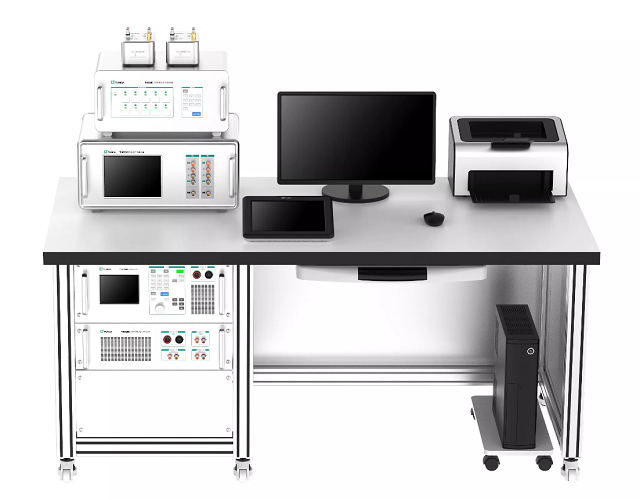
All components of the system can be controlled by computer software, and after the user is wired, it can realize automatic calibration, automatic saving of the original data of the inspected equipment, and automatic export/printing of calibration certificate.
6. How The System Works
6.1 Shunt Calibration (Direct Measurement Method)
The
software automatically controls the rapid commutation of the current source to
remove the effects of the thermoelectric potential. This method is suitable for DC shunts with lower accuracy of class 0.02 and below, and
can achieve automatic and fast measurement.
Description of the test:
• A bipolar
high-current source is used to output a standard current as theI1 input
to the DC shunt under test.
• Measure
the secondary output voltage U2 of the shunt under test
directly using a nanovoltmeter.
• After the
shunt reaches thermal equilibrium, the resistance of the shunt is
calculated according to R=U 2I1.
• After the
user has completed the wiring, fully automatic calibration can be realized
through the computer and system software.
6.2 Shunt Calibration (Comparative Method)
Comparative method features: the use of bipolar high-current
standard source with ultra-precision current proportional
extender (can be cascaded), ultra-stable standard resistance, standard
resistance measurement device through current polarity exchange can achieve
ultra-high accuracy resistance transmission, suitable for calibrating 0.02 and above
high-precision DC shunt, by the software automatically control the rapid
commutation of the current source to remove the influence of thermoelectric
potential.
Description
of the test:
• For DC
shunt calibration with nominal current I 1≥100 A, a bipolar
high-current source is used to output a standard current as the I1 input
to the shunt under test, and 1 000:1, 3 000 are selected according to the input
current The TH 0780 ultra-precision current ratio extender of three
specifications: 1, 1 0000:1 is connected in series with the primary side of the
shunt under test.
• The
secondary output of the high-current TH 0780 is connected to the integrated TH
0780 in a dual-channel chassis, and its secondary output is
connected to the external excitation input of the TH0740 A.
• Connect
the TH0330 ultra-stable standard resistor with a known
resistance value to the A channel of the TH 0740 A (the
user can program the TH0770 to switch the standard resistor
with different resistance specifications).
• The
B-channels P 1 and P 2 of the output
voltage TH0740 A of the shunt will be shortened to terminals C 1 and C2.
• When the
TH0740A internal bridge is balanced, the resistance of the shunt under test is
measured.
• After the
user has completed the wiring, fully automatic calibration can be realized
through the computer and system software.
Description of the test:
• For the
calibration of DC shunts with a nominal current of less than or equal to 100 A, the
TH 1860 ultra-stable constant current source is used to output a standard
current as the I1 input to the sensor under test.
• Pass the
I 1 into the primary side of the TH0780 Ultra-Precision
Current Proportional Extender (integrated in a dual-channel chassis) and the
system automatically selects 1 000:1, 100:1,1 0 based
on the input current : 1 scale;
Its secondary output is connected to the external excitation input of the
TH0740A.
• Connect
the TH 0330 ultra-stable standard resistor with known resistance value to the A
channel of the TH 0740 A (the user can program the TH0770 to switch
the standard resistor with different resistance specifications).
• The
B-channels P 1 and P 2 of the output
voltage TH0740 A of the shunt will be shortened to terminals C 1 and C2.
• When the
TH0740A internal bridge is balanced, the resistance of the shunt under test is
measured.
• After the
user has completed the wiring, fully automatic calibration can be realized
through the computer and system software.
6.3 For DC
shunts or standard resistors with nominal current of 0.1 mA ≤ I1 ≤ 1 A, TH 0330 and
TH can be used directly 0740A direct calibration.
Description
of the test:
• Connect a
TH0330 ultra-stable standard resistor of known value to
the A channel of TH 0740 A
(Note: Users can switch standard resistors with different
resistance specifications through TH0770 program control). 。
• The DC
shunt or standard resistor is connected to the B channel of the TH0740A.
• When the
TH0740A internal bridge is balanced, the resistance of the shunt under test is
measured.
• After the
user has completed the wiring, fully automatic calibration can be realized
through the computer and system software.
6.4 Sensor Calibration (Direct Measurement Method)
This method is
suitable for sensor testing with lower accuracy of class 0.02 and
below,
enabling fast and automated measurements.
Description of the test:
• A bipolar
high-current source is used to output a standard current as theI1 input
to the sensor under test.
• The
current signal I 2 (current type) or voltage signal U2 (voltage
type) output by the tested sensor is
connected to the secondary signal measurement unit of the sensor, and the
primary current I1 is combined to realize the
calibration of the sensor ratio.
• After the
user has completed the wiring, fully automatic calibration can be realized
through the computer and system software.
6.5 Sensor Calibration (Comparative Method)
Comparative method features: the use
of bipolar high-current standard source with ultra-high accuracy
ultra-precision current proportional extender (can be cascaded), ultra-stable
standard resistance, standard resistance measurement device through current
polarity exchange can achieve ultra-high accuracy
ratio transmission, suitable for calibrating 0.02 level and
above high-precision current sensors.
Description
of the test:
• For the calibration of current sensors with a nominal current greater than or equal to 1
00 A, a bipolar high-current source is used to output a standard current as
the I1 input to the sensor under test, and 1 000:1, 3
000:1, 10000 are selected according to the input current :1 The TH0780
ultra-precision current proportional extender of three sizes is connected in
series with the primary side of the sensor under test.
• The
secondary output of the tested sensor and the high-current specification TH
0780 is connected to the integrated TH0780 of the
dual-channel chassis, and the secondary output of the dual channel is connected
to two TH 0330 ultra-stable standard resistors with known resistance values for
I/V conversion.
• Then
connect the voltage signals U1 and U2 of
the two standard resistors to TH0740A for voltage ratio
measurement.
• After the
user has completed the wiring, fully automatic calibration can be realized
through the computer and system software.
Description of the test:
• For the
calibration of current sensors with a nominal current of less than or
equal to 1 00 A, the TH 1860-100A ultra-stable constant current
source is used to output the standard current as the I1 input to the tested
sensor; Pass I 1 into the primary side of the A channel of the
TH0780 ultra-precision current proportional extender (integrated in a
dual-channel chassis), and the system automatically selects 1
000:1, 100:1, 1 based on the input current 0:1 ratio.
• The
secondary output of the sensor under test is connected to the primary side of
the B channel of the TH0780.
• The dual
secondary outputs of the TH0780 are connected to two TH 0330 ultra-stable
standard resistors of known resistance for I/V conversion.
• Then
connect the voltage signals U1 and U2 of
the two standard resistors to TH0740A for voltage ratio
measurement.
• After the
user has completed the wiring, fully automatic calibration can be realized
through the computer and system software.